



|
|
||||
|
||||
|
||||
|
||||
|
||||
|
||||
|
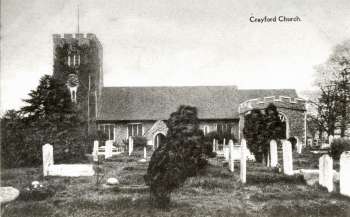
On Saturday 30th July, in St. Paulinus Church in Crayford, Kent, a past member of our choir, Sarah Monk, is to be married. I am sure you will all join me in wishing Sarah and her husband all happiness in their life together. I first heard of this during the Parish Luncheon while sitting at the table with Rosemary and Colin. I was intrigued. Not by the fact that Sarah was getting married, but by the name Paulinus. I had never heard of him, or them, as it so happened. There are in fact three saints with the name Paulinus, of Padua, of Nola and of York. A quick enquiry to the church's website confirmed that the patronym was from St. Paulinus of York. The Parish Administrator very kindly sent me a copy of the History of the Church, which makes very interesting reading. And here, very briefly, is what I managed to find out about Paulinus. In the middle 400's the pagan Anglo-Saxons invaded Britain and drove the Christian Britons north and west into Cornwall, Wales, Scotland, and Ireland. In 597 a band of monks headed by Augustine of Canterbury were sent by St. Gregory the Great to Britain to try to reverse this. They landed in south-eastern England, in the kingdom of Kent, and began to convert the people to Christianity. They were quite successful in this, so, in 601 a second group of monks was sent to assist Augustine. This group included Paulinus, at that time about 32 years old. According to the records of the time he was a 'tall man with a slight stoop, who had black hair, a thin face and a narrow, aquiline nose, his presence being venerable and awe-inspiring'. Paulinus laboured in Kent until 625 when he went north to Northumbria. The reason for this started back in 616 when Edwin, King of Northumbria, whose kingdom stretched from the Humber to the Clyde and the Forth, asked for the hand in marriage of Ethelburga, the sister of King Eadbald of Kent. Edwin was a pagan, and was told in no uncertain terms that a Christian princess could not marry him. But Edwin was a man who knew what he wanted and was determined to get it. Negotiations took place over several years. First he promised that Ethelburga would be free to follow her religion, and when this was not enough, he said he would listen to Christian preachers and would even consider becoming a Christian himself. At this Ethelburga agreed to marry him, and went north in 625, taking with her as chaplain the monk Paulinus, who was consecrated bishop by St. Justus, Archbishop of Canterbury, for the purpose. Paulinus held a famous conference with the highest Northumbrian thegns, probably at a Royal Palace in Londesborough in the East Riding of Yorkshire. Here he explained to them the advantages of the Christian religion, illustrating his arguments thus: "This is how the present life of man on Earth appears to me in comparison with that time which is unknown to us. You are sitting feasting with your friends in a great hall in winter time. The fire is burning on the hearth in the middle of the hall and all inside is warm, while outside the wintry storms of rain and snow are raging, when a sparrow flies swiftly through the hall. It enters in at one door and quickly flies out through the other. For the few moments it is inside, the storm and wintry tempest cannot touch it, but after the briefest moment of calm, it flits from your sight, out of the wintry storm and into it again. So this life of man appears but for a moment. What follows or, indeed, what went before, we know not at all." Having been offered hope of life after death, the court was won over. Even the King's pagan high priest, Coifi, was converted. He rode out to the great pagan temple at Goodmanham, a very short distance from Londesborough, threw a spear into it and began its demolition. The present parish church there may possibly occupy the site. Shortly after this conference, the baptism of Edwin took place, at York, on Easter Day in 627. Two of his children, and many other persons of noble birth, were baptised at the same time. Round the baptistery, which had been hastily built, the King caused a small wooden church to be constructed ™ the first York Minster. It stood somewhere in the vicinity of the present Minster. Other conversions followed, and the Church in Northumbria flourished. Unfortunately this state of affairs didn't last long. Six years later, in 633, King Edwin was defeated and killed by Cadwallon of Wales and Penda of Mercia at the battle of Hatfield Chase. It was unsafe for the queen to stay there, and so Paulinus took Ethelburga and her children back to Kent by ship, leaving his deacon James in charge of what remained of the Church there. Bishop Romanus of Rochester had just died, and the elderly Paulinus was immediately given his See. International communications were, not surprisingly, poor in those days and, unaware of this new state of affairs, Pope Honorius I wrote to King Edwin and Archbishop Honorius of Canterbury in June the following year, sending the pallium, that band worn only by the Pope and Archbishops, to the now exiled Paulinus. Paulinus was now Archbishop of York. But Paulinus never visited York again. He presided over the See of Rochester until his death on 10 October 644. He was buried in the chapter-house of Rochester cathedral, but, on its rebuilding, his relics were translated by Archbishop Lanfranc to a silver shrine where they lay till the Reformation. His festival is observed in England on 10 October, the anniversary of his death. Bill Hutchings |
|
page last updated |