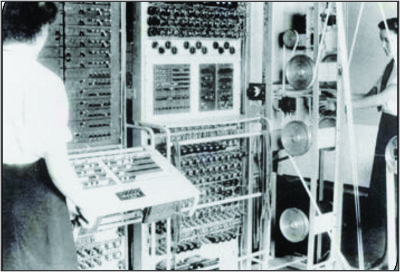
Last October, twenty five of us visited Bletchley Park, which housed the Government Code & Cypher School and became the principal centre of Allied code-breaking during WW2. The codebreakers regularly penetrated the secret communications of the Axis Powers, most importantly the German Enigma and Lorenz ciphers.
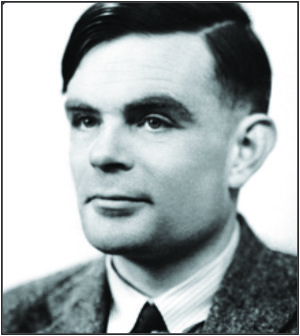
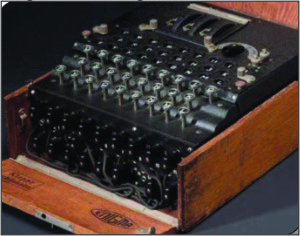
Amongst the codebreakers the most well known is Alan Turing, who led the section responsible for German naval cryptanalysis. He devised techniques for speeding the breaking of German ciphers, including improvements to the prewar Polish bombe method, an electromechanical machine that could find settings for the Enigma machine.
He played a crucial role in cracking intercepted messages that enabled the Allies to defeat the Axis powers, especially in the Battle of the Atlantic. There is a life sized statue of Turing, beautifully made from slate pieces, and is a striking memorial to him.
There were free guided tours around the site and we learned interesting facts such as that President Roosevelt sent 400 Americans in August 1939 to assist the British (he didn’t tell Congress nor the military about this).
The team at Bletchley Park, 75% of whom were women, devised automatic machinery to help with decryption, culminating in the development of Colossus, the world’s first programmable digital electronic computer. Codebreaking operations at Bletchley ended in 1946 and all information about the wartime activity was classified until the mid-1970s.
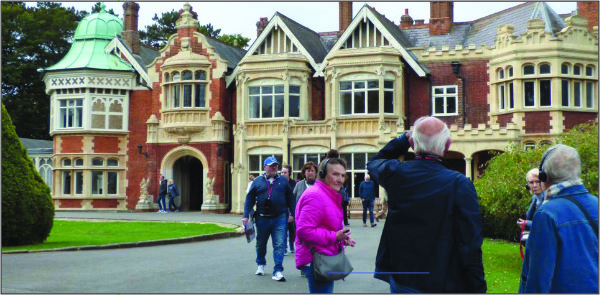
The mansion itself was clearly beautiful in its heyday. It had been purchased by the Head of SIS/MI6 in 1938 in case of war, bought with his own money as the government claimed it couldn’t afford it. It was ideally placed halfway between Oxford and Cambridge (whose universities would be expected to supply code breakers) and near to a telegraph and telephone repeater station.
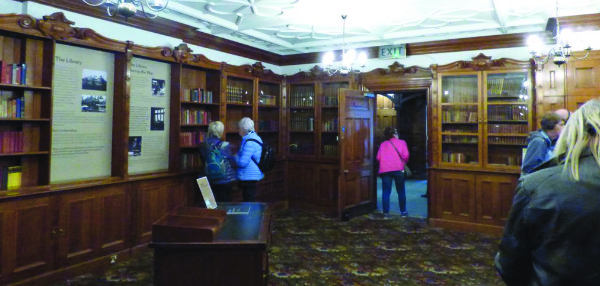
I had visited Bletchley Park a year or two before the Covid lockdown and was impressed by the improvements in “the visuals” since then, with many more explanatory displays and videos, no doubt afforded by the Heritage Lottery Funding the museum received.
If you visited the site a few years ago it would be well worth returning to visit it now.
Rosy Stone